Just be Green
- Green Power -
Related



SOLAR POWER
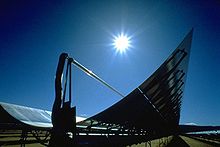
Solar power is the generation of electricity from sunlight. This can be direct as with photovoltaics (PV), or indirect as with concentrating solar power (CSP), where the sun's energy is focused to boil water which is then used to provide power.

Solar power has the potential to provide over 1,000 times total world energy consumption in 2008, though it provided only 0.02% of the total that year. If it continues to double in use every two to three years, or less, it would become the dominant energy source this century. The largest solar power plants, like the 354 MW SEGS, are concentrating solar thermal plants, but recently multi-megawatt photovoltaic plants have been built. Completed in 2008, the 46 MW Moura photovoltaic power station in Portugal and the 40 MW Waldpolenz Solar Park in Germany are characteristic of the trend toward larger photovoltaic power stations. Much larger ones are proposed, such as the 100 MW Fort Peck Solar Farm, the 550 MW Topaz Solar Farm, and the 600 MW Rancho Cielo Solar Farm. Solar power is a predictably intermittent energy source, meaning that whilst solar power is not available at all times, we can predict with a very good degree of accuracy when it will and will not be available. Some technologies, such as solar thermal concentrators have an element of thermal storage, such as molten salts. These store spare solar energy in the form of heat which is made available overnight or during periods that solar power is not available to produce electricity.
A solar cell, or photovoltaic cell (PV), is a device that converts light into electric current using the photoelectric effect. This is based on the discovery by Alexandre-Edmond Becquerel who noticed that some materials release electrons when hit with rays of photons from light, which produces an electrical current. The first solar cell was constructed by Charles Fritts in the 1880s. There are many competing technologies, including fourteen types of photovoltaic cells, such as thin film, monocrystalline silicon, polycrystalline silicon, and amorphous cells, as well as multiple types of concentrating solar power. It is too early to know which technology will become dominant.
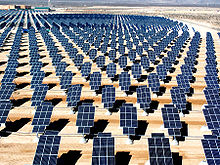
Solar cells produce direct current electricity from light, which can be used to power equipment or to recharge a battery. The first practical application of photovoltaics was to power orbiting satellites and other spacecraft. Cells require protection from the environment and are usually packaged tightly behind a glass sheet. When more power is required than a single cell can deliver, cells are electrically connected together to form photovoltaic modules, or solar panels. A single module is enough to power an emergency telephone, but for a house or a power plant the modules must be arranged in multiples as arrays.
Concentrating Photovoltaics and Thermal (CPVT) technology produces both electricity and thermal heat in the same module. Thermal heat that can be employed for hot tap water, heating and heat-powered air conditioning (solar cooling), desalination or solar process heat. CPVT systems can be used in private homes and increase total energy output to 40-50%, as compared with normal photovoltaic panels with 10-20% efficiency, and they produce more thermal heat in wintertime compared with normal thermal collectors. Also, thermal systems do not overheat. Australian, American, and Chinese researchers are exploring the potential for Combined Heat and Power Solar (CHAPS), while Europeans are now producing CHAPS systems.
Text and Photos source Wikipedia, the free encyclopedia.
Also the site uses images from PD Photo.org
Copyright ©John Template Designed by Alpha Studio