Just be Green
- Green Power -
Related



WIND POWER
Wind power is the conversion of wind energy into a useful form of energy, such as using wind turbines to make electricity, wind mills for mechanical power, wind pumps for pumping water or drainage, or sails to propel ships.

At the end of 2008, worldwide nameplate capacity of wind-powered generators was 121.9 gigawatts (GW). Energy production was 260 TWh, which is about 1.5% of worldwide electricity usage; and is growing rapidly, having doubled in the three years between 2005 and 2008. Several countries have achieved relatively high levels of wind power penetration (with large governmental subsidies), such as 19% of stationary electricity production in Denmark, 13% in Spain and Portugal, and 7% in Germany and the Republic of Ireland in 2008. As of May 2009, eighty countries around the world are using wind power on a commercial basis.
Large-scale wind farms are connected to the electric power transmission network; smaller facilities are used to provide electricity to isolated locations. Utility companies increasingly buy back surplus electricity produced by small domestic turbines. Wind energy as a power source is attractive as an alternative to fossil fuels, because it is plentiful, renewable, widely distributed, clean, and produces no greenhouse gas emissions. However, the construction of wind farms is not universally welcomed because of their visual impact and other effects on the environment.
Wind turbines can rotate about either a horizontal or vertical axis, the former being more common.
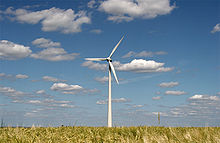
Horizontal-axis wind turbines (HAWT) have the main rotor shaft and electrical generator at the top of a tower, and must be pointed into the wind. Small turbines are pointed by a simple wind vane, while large turbines generally use a wind sensor coupled with a servo motor. Most have a gearbox, which turns the slow rotation of the blades into a quicker rotation that is more suitable to drive an electrical generator. Since a tower produces turbulence behind it, the turbine is usually pointed upwind of the tower. Turbine blades are made stiff to prevent the blades from being pushed into the tower by high winds. Additionally, the blades are placed a considerable distance in front of the tower and are sometimes tilted forward into the wind a small amount.

Vertical-axis wind turbines (or VAWTs) have the main rotor shaft arranged vertically. Key advantages of this arrangement are that the turbine does not need to be pointed into the wind to be effective. This is an advantage on sites where the wind direction is highly variable. With a vertical axis, the generator and gearbox can be placed near the ground, so the tower doesn't need to support it, and it is more accessible for maintenance. Drawbacks are that some designs produce pulsating torque.
Text and Photos source Wikipedia, the free encyclopedia.
Also the site uses images from PD Photo.org
Copyright ©John Template Designed by Alpha Studio