Just be Green
- Green Power -
Related



TIDAL POWER
Tidal power, sometimes also called tidal energy, is a form of hydropower that converts the energy of tides into electricity or other useful forms of power. Although not yet widely used, tidal power has potential for future electricity generation. Tides are more predictable than wind energy and solar power.
Tidal power is the only form of energy which derives directly from the relative motions of the Earth-Moon system, and to a lesser extent from the Earth-Sun system. The tidal forces produced by the Moon and Sun, in combination with Earth's rotation, are responsible for the generation of the tides. Other sources of energy originate directly or indirectly from the Sun, including fossil fuels, conventional hydroelectric, wind, biofuels, wave power and solar. Nuclear is derived using radioactive material from the Earth, geothermal power uses the Earth's internal heat which comes from a combination of residual heat from planetary accretion (about 20%) and heat produced through radioactive decay (80%).Tidal energy is generated by the relative motion of the water which interact via gravitational forces. Periodic changes of water levels, and associated tidal currents, are due to the gravitational attraction by the Sun and Moon. The magnitude of the tide at a location is the result of the changing positions of the Moon and Sun relative to the Earth, the effects of Earth rotation, and the local shape of the sea floor and coastlines.
Tidal power can be classified into three main types:
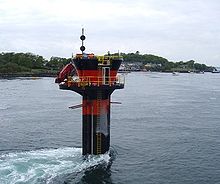
-Tidal stream systems make use of the kinetic energy of moving water to power turbines, in a similar way to windmills that use moving air. This method is gaining in popularity because of the lower cost and lower ecological impact compared to barrages.
-Barrages make use of the potential energy in the difference in height (or head) between high and low tides. Barrages are essentially dams across the full width of a tidal estuary, and suffer from very high civil infrastructure costs, a worldwide shortage of viable sites, and environmental issues.
-Tidal lagoons, are similar to barrages, but can be constructed as self contained structures, not fully across an estuary, and are claimed to incur much lower cost and impact overall. Furthermore they can be configured to generate continuously which is not the case with barrages.
The higher density of water, 800 times the density of air, means that a single generator can provide significant power at low tidal flow velocities (compared with wind speed). Given that power varies with the density of medium and the cube of velocity, it is simple to see that water speeds of nearly one-tenth of the speed of wind provide the same power for the same size of turbine system. However this limits the application in practice to places where the tide moves at speeds of at least 2 knots (1m/s) even close to neap tides.
Text and Photos source Wikipedia, the free encyclopedia.
Also the site uses images from PD Photo.org
Copyright ©John Template Designed by Alpha Studio